Cyber threats today don’t discriminate based on company size. From ransomware attacks to phishing campaigns and data breaches, organizations of every scale face growing cybersecurity threats. However, the approach to cybersecurity varies significantly between small and medium-sized businesses (SMBs) and large enterprises.
The difference lies not only in the scale of infrastructure but also in resources, expertise, and operational complexity. To remain resilient against evolving threats, businesses must adopt cybersecurity solutions tailored to their specific needs.
Why Cybersecurity Matters for Businesses of All Sizes
Digital transformation has expanded the attack surface for companies across industries. Cloud applications, remote work, IoT devices, and interconnected systems create multiple entry points for cybercriminals.
SMBs are often considered attractive targets because they may lack dedicated cybersecurity teams or advanced tools. Limited budgets and technical expertise can make it difficult for smaller organizations to implement comprehensive security programs.
At the same time, enterprises face their own challenges. With complex IT environments, vast amounts of sensitive data, and global operations, they require advanced security architectures and continuous monitoring to protect their systems.
This is why modern cybersecurity strategies focus on tailored protection rather than a one-size-fits-all approach.
Cybersecurity Needs of SMBs
For SMBs, cybersecurity solutions must strike a balance between effective protection and operational simplicity.
1. Cost-Effective Security
Most SMBs operate within tight budgets and cannot invest in large-scale security infrastructure. Affordable solutions with flexible pricing models are essential to ensure protection without overwhelming financial resources.
2. Simplified Deployment
Unlike enterprises, SMBs rarely have large IT teams. Many depend on a small internal team or outsourced providers to manage their systems. Security tools therefore need to be easy to deploy, manage, and maintain.
3. Automated Threat Detection
Automation plays a key role in SMB cybersecurity. AI-powered monitoring, vulnerability scanning, and automated patching help organizations identify threats without requiring specialized expertise.
4. Endpoint and Email Security
Phishing, malware, and credential theft remain the most common attack vectors for smaller businesses. Strong endpoint protection, email filtering, and multi-factor authentication are essential.
5. Managed Security Services
Many SMBs rely on Managed Security Service Providers (MSSPs) to monitor threats, manage firewalls, and respond to incidents. This approach allows them to access enterprise-grade security capabilities without building a large internal team.
Cybersecurity Needs of Enterprises
Large enterprises operate in a much more complex IT environment. Their cybersecurity strategies are designed to protect large volumes of sensitive data across distributed networks.
1. Advanced Security Architecture
Enterprises deploy layered security frameworks including Security Information and Event Management (SIEM), intrusion detection systems (IDS), and data loss prevention (DLP) to monitor and protect their infrastructure.
2. Dedicated Security Teams
Large organizations typically maintain Security Operations Centers (SOCs) staffed with cybersecurity analysts, threat hunters, and incident response specialists who monitor networks around the clock.
3. Compliance and Governance
Enterprises must comply with strict regulatory frameworks such as GDPR, HIPAA, and PCI DSS. Their cybersecurity programs therefore include extensive compliance monitoring, auditing, and risk management processes.
4. Zero Trust Security Models
Modern enterprises increasingly adopt Zero Trust architectures, where every user and device must continuously verify identity before accessing systems.
5. Integration Across Systems
Enterprise environments often include multiple platforms, applications, and cloud services. Security solutions must integrate seamlessly across these systems to maintain centralized visibility.
Key Differences Between SMB and Enterprise Cybersecurity
| Aspect | SMB Cybersecurity | Enterprise Cybersecurity |
| Budget | Limited | High investment |
| IT Team | Small or outsourced | Dedicated security teams |
| Complexity | Simpler infrastructure | Complex multi-layer environments |
| Tools | Easy-to-manage solutions | Advanced integrated platforms |
| Security Approach | Automation and managed services | Custom architectures and SOC monitoring |
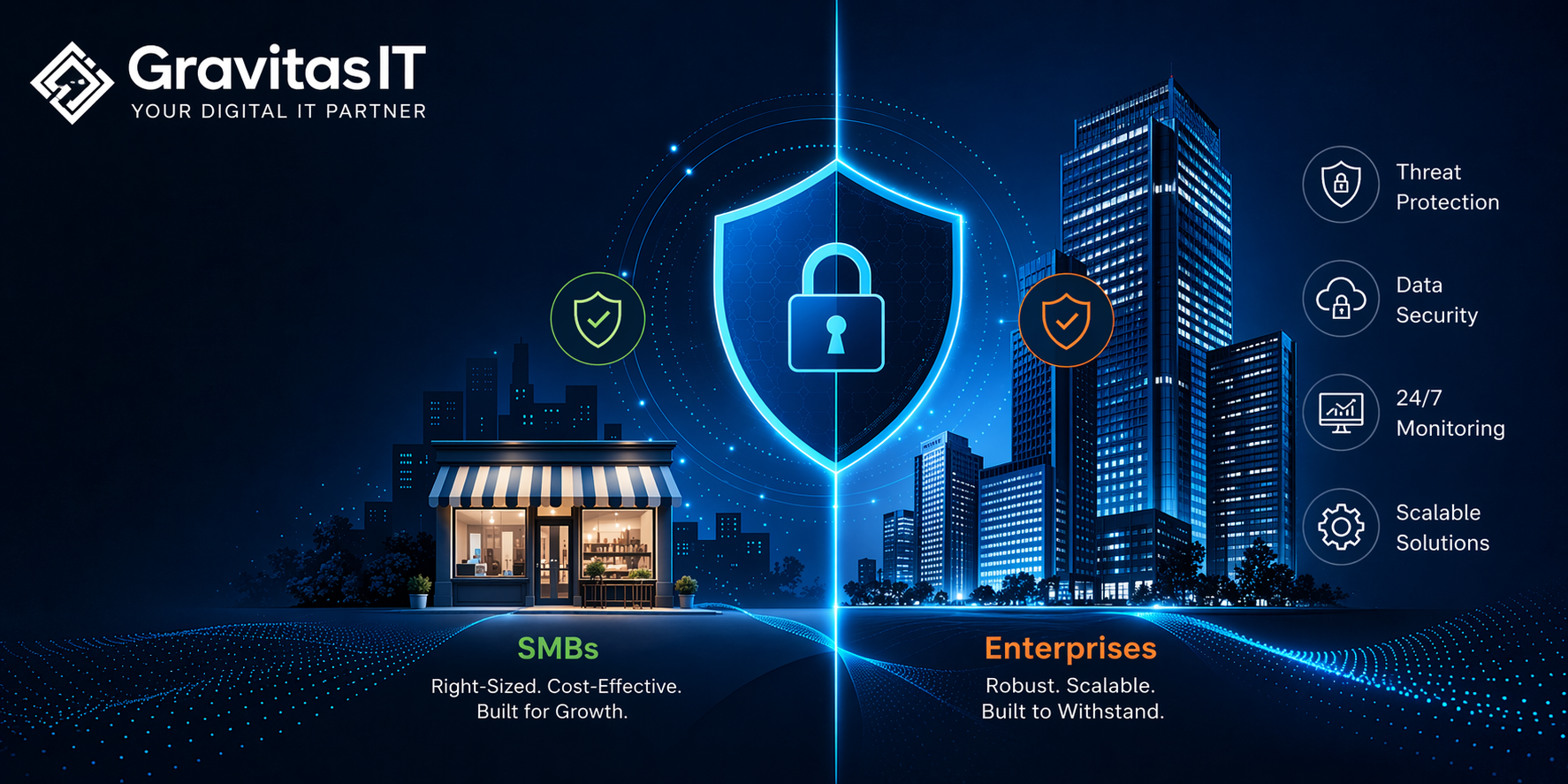
While enterprises prioritize scale and complexity, SMBs focus on simplicity, affordability, and efficiency.
The Rise of Scalable Cybersecurity Platforms
One of the most significant trends in cybersecurity is the rise of scalable solutions that adapt to different business sizes. Modern platforms provide modular capabilities such as threat detection, vulnerability management, identity protection, and compliance monitoring.
This approach allows businesses to start with essential protection and expand security capabilities as they grow.
Companies like ThIRU Labs are contributing to this shift by offering cybersecurity solutions designed to address the evolving needs of organizations while ensuring strong protection against modern threats.
A Growing Opportunity for Cybersecurity Resellers
As cyber threats continue to escalate, businesses across industries are actively seeking reliable cybersecurity partners. This creates a major opportunity for IT service providers, MSPs, and technology consultants to expand their portfolios with trusted cybersecurity solutions.
Partnering with cybersecurity services providers like Gravitas enables resellers to deliver advanced cybersecurity protection to both SMBs and enterprises while building a scalable revenue stream.
If you’re a managed service provider, IT consultant, or technology reseller, now is the perfect time to explore opportunities to resell ThIRU. By joining the ThIRU partner ecosystem, you can offer powerful cybersecurity solutions to your clients while growing your own business in one of the fastest-growing technology markets.
Become a ThIRU reseller today and empower businesses with smarter, stronger cybersecurity protection.